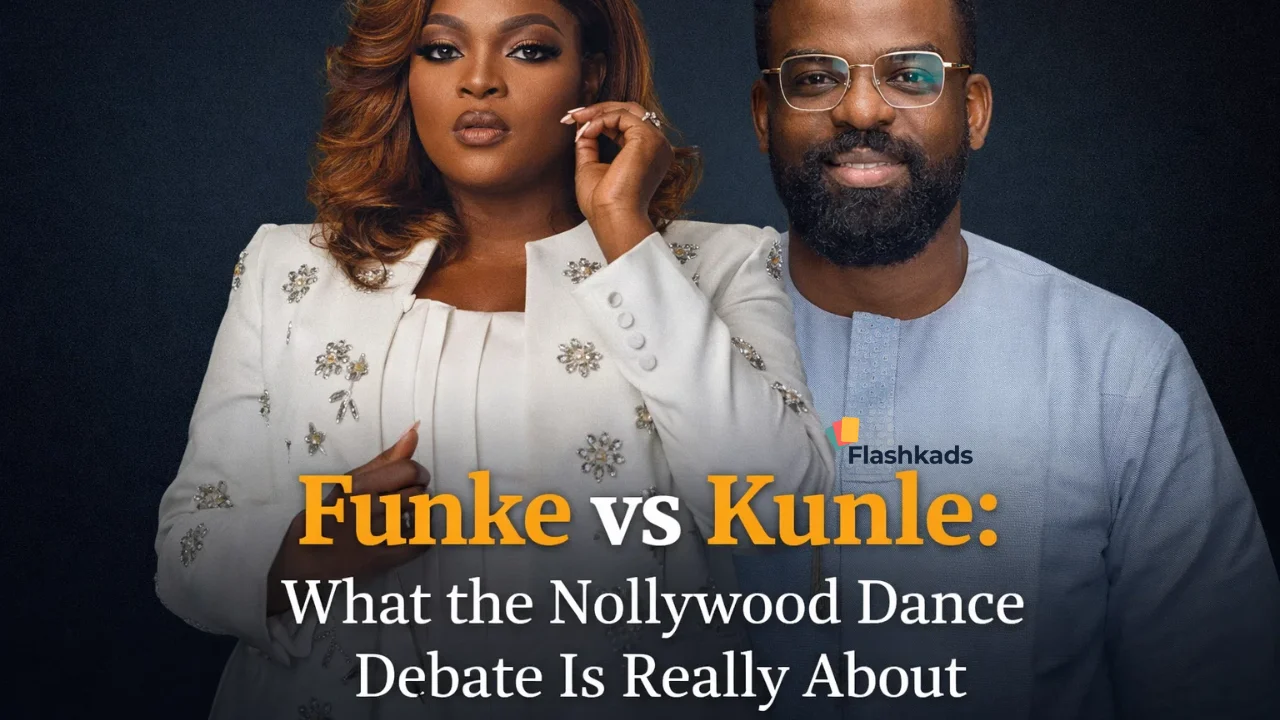
I did not intend to have a strong opinion on the recent back-and-forth involving two of the biggest stars in Nollywood, Kunle Afolayan and Funke Akindele. At first glance, it appeared to be one of those fleeting industry disagreements that flare up, dominate social media for a few days, and then quietly dissolve. Yet the more I followed the rhetoric, the more it became clear that this conversation was touching something deeper than TikTok trends or marketing gimmicks. What we are really witnessing is an industry negotiating its identity in real time.
Nollywood, it must be said, is enjoying one of its most successful moments. Nigerian films are no longer struggling for relevance or visibility. Streaming platforms commission original content with confidence, cinema attendance has grown significantly, and box office figures that once seemed impossible are now becoming familiar.
Funke Akindele’s recent films, which have consistently crossed the billion-naira mark, represent more than personal success. They signal a shift in what is possible for Nigerian cinema when audience engagement, timing, and strategy align.
It was against this backdrop that Kunle Afolayan, speaking at a recent industry forum, made a comment that quickly became the centre of debate. He expressed concern about the current expectation that filmmakers must engage in relentless promotional performance, stating that he wanted to make a film on the condition that he would not be required to “dance” to sell it.
While the comment was not explicitly directed at anyone, its implications were immediately clear, particularly in an industry where Funke Akindele’s energetic, highly visible promotional style has become almost inseparable from her box office success.
To some, the statement sounded dismissive, even condescending. To others, it sounded like exhaustion. Personally, I heard something else entirely: discomfort with a changing professional reality. Kunle Afolayan represents a generation of filmmakers trained to believe that the work itself should command attention through craft, storytelling, and cultural depth. For filmmakers shaped by that tradition, the idea that visibility now requires performative marketing can feel unsettling, even reductive.
Funke Akindele’s response, both direct and indirect, revealed the emotional undercurrent of the issue. Her approach to film promotion is immersive and unapologetic. She shows up everywhere, often in character, engaging audiences across platforms, leaning fully into humour, dance, skits, and interaction. For her, marketing is not separate from storytelling; it is an extension of it. When someone suggests that such effort is excessive or undesirable, it does not land as a neutral critique. It feels personal.
What complicates the conversation further is the assumption that this is a uniquely Nigerian dilemma. It is not. Globally, the boundaries between filmmaking, marketing, and digital performance have blurred. Film casts participate in viral trends, actors turn press tours into online entertainment, and promotional campaigns are now designed with algorithmic attention in mind. From Hollywood to streaming platforms, visibility has become participatory. Audiences no longer merely watch films; they interact with them long before release.
The real issue, then, is not whether dancing is appropriate, but whether the industry has adequately adapted its structures to support different kinds of creators. Promotion has become unavoidable, yet not every filmmaker has the personality, stamina, or inclination to be constantly visible. The problem is not that some people dance; it is that others feel pressured to do so without alternative systems in place. Ideally, an evolving industry should expand options rather than narrow them.
Framing this debate as a question of respectability versus relevance does a disservice to everyone involved. Funke Akindele’s success does not diminish artistic integrity simply because it is loud or accessible. Kunle Afolayan’s preference for restraint does not make him outdated or elitist. They represent different responses to the same changing environment, shaped by experience, temperament, and creative philosophy.
In truth, Nollywood is growing in public, and growth is rarely graceful. Old assumptions are colliding with new realities, and tensions are inevitable. What matters is resisting the urge to moralise success or diminish methods that differ from our own. An industry thrives when it allows multiple paths to coexist without hierarchy or ridicule.
Perhaps the simplest conclusion is the most reasonable one. There is room for the filmmaker who dances and the one who does not. There is space for spectacle and for subtlety, for mass appeal and for quiet artistry. What should unite the industry is not uniformity of method, but mutual respect for the labour behind every story.
After all, behind every viral clip and every carefully composed frame is the same desire: to be seen, to be heard, and to have one’s work matter. That, more than any dance step, is what deserves attention.