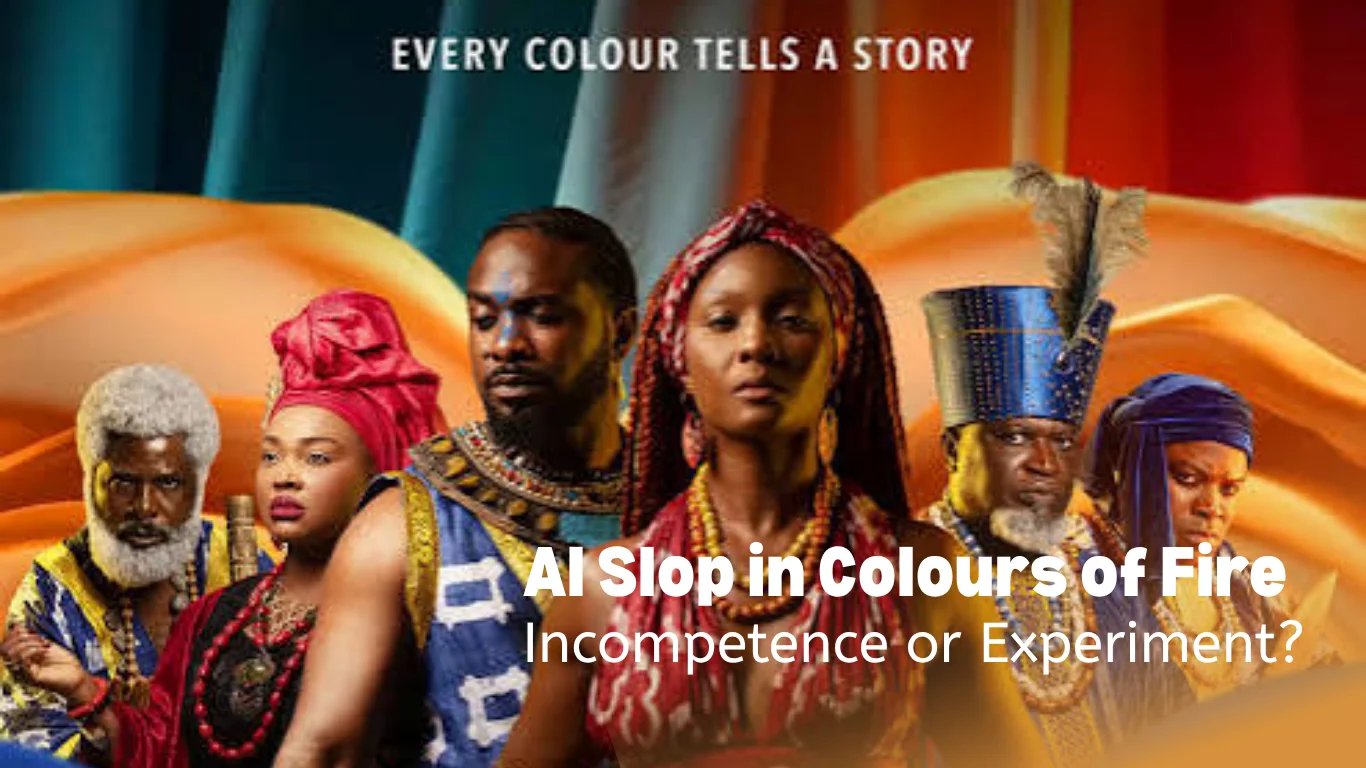
There is something particularly frustrating about watching a film that clearly has money, talent, and ambition behind it, yet repeatedly makes choices that cheapen the very world it is trying to build. That was my experience watching Niyi Akinmolayan’s Colours of Fire.
Released in Nigerian cinemas on December 24, 2025, the film stars Uzor Arukwe, Osas Ighodaro, Gabriel Afolayan, Mercy Aigbe, Femi Branch and Ibrahim Chatta. Akinmolayan has described the project as part of what he calls Afrofusion, a cinematic approach combining African mythology, fashion, visual effects and technology.
On paper, it sounds exciting, and in several parts of the film, it actually is. But Colours of Fire also raises an uncomfortable question about the growing relationship between artificial intelligence and filmmaking: when does experimentation stop being innovation and simply start looking cheap?
Whatever the intention behind some of the AI-generated sequences in this film, the results often look less like the future of Nigerian cinema and more like unfinished concept art accidentally left in the final cut.
Before discussing what went wrong, Colours of Fire deserves credit for what it gets right, because the ambition behind the project is obvious.
Nollywood has spent decades working within production limitations, and something is refreshing about seeing a filmmaker attempt a fantasy world on this scale rather than retreating into another familiar contemporary drama.
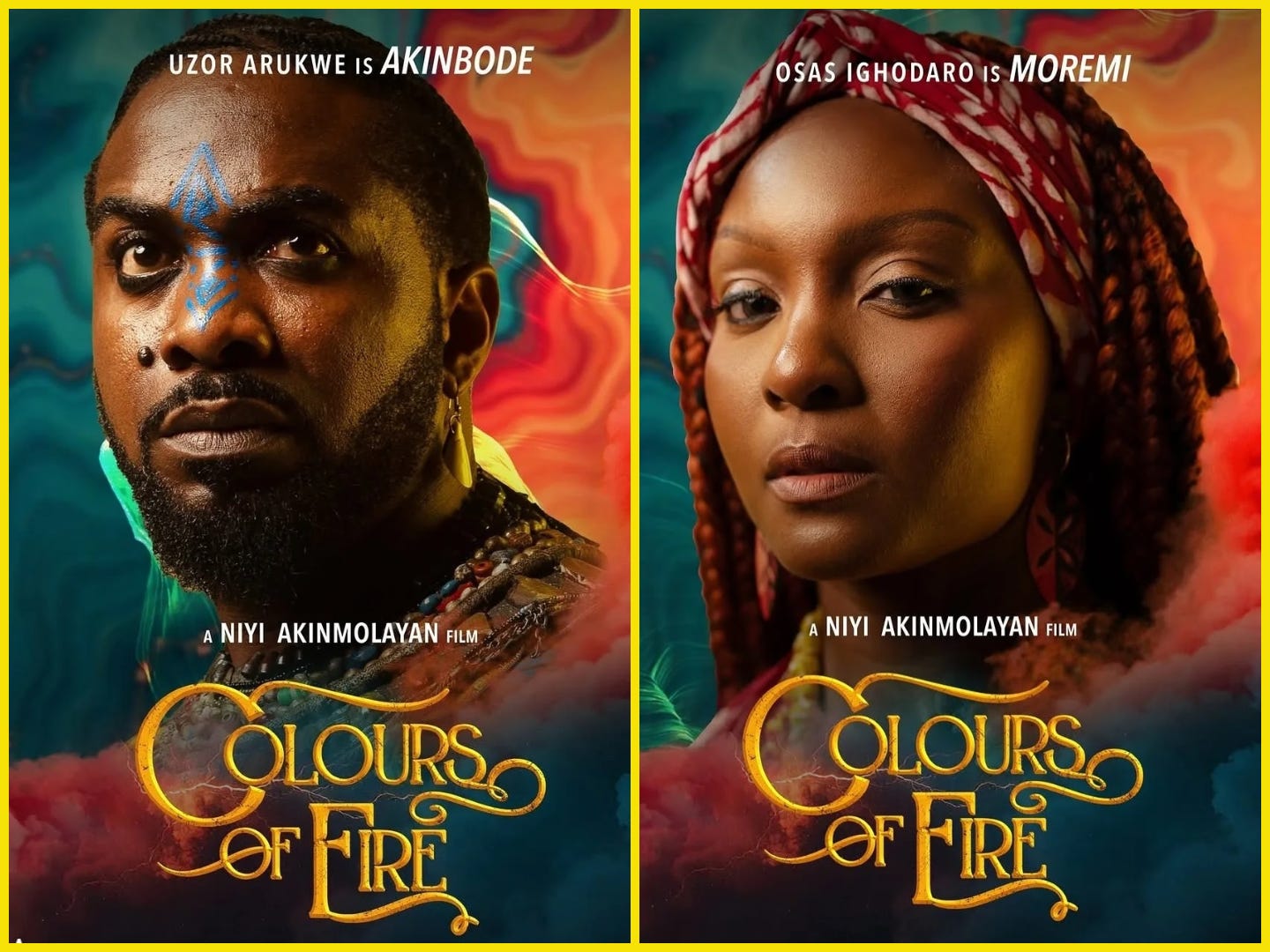
The basic premise has potential too. The film builds its story around two rival societies, the Blue and Red tribes, whose hatred for one another is sustained largely by myths, fear, and inherited misinformation. Akinbode, played by Uzor Arukwe, is sent to confront what he has been taught is a monstrous threat, only to discover that reality is far more complicated than the stories he inherited.
There is an interesting film inside that idea, one that allows Colours of Fire to explore prejudice, propaganda, tribal identity and the ease with which societies manufacture enemies.
Visually, the practical elements of the production are often impressive. The costumes are probably among the film’s strongest achievements. The fabrics, beads, headpieces and colour combinations give the tribes distinct identities, while the production design frequently creates the impression of a much bigger world beyond what we see on screen. Critics have similarly praised the film’s costumes, set design, cinematography and performances.
The soundscape also works surprisingly well. The chants, music and percussion give several sequences the grand, theatrical quality the film is clearly chasing. Gabriel Afolayan is particularly effective whenever the screenplay gives him enough room to perform, while Uzor Arukwe commits completely to Akinbode. Osas Ighodaro also brings enough presence to Moremi that the character remains interesting even when the writing around her becomes less convincing.
So this is not an incompetent production from top to bottom, and that is exactly what makes its failures more irritating.
One of the first mistakes Colours of Fire makes is assuming that explaining its world is the same thing as immersing us in it. It is not.
The opening spends far too much time having a narrator explain the mythology, history and relationship between these tribes. Fantasy films obviously require world-building, but good world-building does not necessarily mean stopping the story so someone can lecture the audience.
Film is a visual medium, so show us.
Let us watch the relationship between these communities deteriorate. Let us discover the mythology through rituals, arguments, conversations, architecture, clothing and character behaviour. Give us information as the characters need it rather than front-loading the story with explanations before we have been given enough reason to care about the world being explained.
The result is immediate distance between the viewer and the film. Just when the exposition is already testing your patience, the artificial-looking imagery arrives, and that is where things become worse.
Several visual sequences appear like AI-generated illustrations stitched together to communicate events that could arguably have been dramatised more effectively through live action, conventional animation, practical filmmaking or carefully executed VFX.
Rather than pulling us deeper into this supposedly ancient African world, these sequences constantly remind us that we are watching manufactured images.
Other reviewers noticed similar problems. TheCable described the AI elements as excessively obvious and argued that the transitions between live action, animation and generated imagery disrupt the film’s realism. Premium Times likewise criticised the production for overreliance on AI-driven visuals.
That matters because the first few minutes of any film are essentially a negotiation with the audience. You are asking viewers to trust you, but Colours of Fire instead gives them narration, exposition and distracting synthetic imagery before its characters have been allowed to properly take control of the story.
For people already sceptical about AI-generated content, that is a brutal first impression. And while it would be inaccurate to call the film an outright box-office disaster, it eventually passed ₦100 million in Nigerian cinemas; its commercial performance should not prevent us from questioning whether the opening cost it some audience enthusiasm.
A blockbuster should make you reluctant to look away. Colours of Fire occasionally makes you wonder whether you want to continue.
This is where my biggest disagreement with the film begins. I am not opposed to AI being used in filmmaking. In fact, Colours of Fire is exactly the kind of film where experimentation with emerging technology could make sense.
Fantasy cinema is expensive. Creating enormous kingdoms, mythical landscapes, armies, magical creatures and historical environments traditionally requires substantial budgets, and Nigerian filmmakers do not have the financial resources available to Hollywood studios producing $150 million fantasy films.
If AI can help Nigerian filmmakers create worlds previously considered financially impossible, filmmakers should absolutely explore it. But experimentation cannot become an excuse for poor output.
The question should never simply be “Can AI generate this?” The more important question is “Does the generated image deserve to appear in the final film?” Those are two completely different standards.
Some of the generated visuals in Colours of Fire feel like first drafts. Faces have that familiar synthetic smoothness, environments sometimes feel more illustrated than inhabited, motion lacks physical weight and the visual language suddenly changes between sequences.
You can almost feel the film switching technologies, and once the audience notices the tool instead of the story, the illusion has already been broken.
This is particularly baffling because generative image and video technology has improved rapidly. Even if the filmmakers deliberately wanted an artificial or illustrated aesthetic, much stronger outputs could have been developed through better prompting, image-to-image workflows, compositing, manual retouching and conventional VFX cleanup.
AI should have been one ingredient in the pipeline. Instead, there are moments where it feels like the pipeline, and that distinction matters.
There is also an irony here: the practical filmmaking in Colours of Fire is often considerably more convincing than its supposedly futuristic technology.
Real costumes look beautiful, real actors have presence and real sets have texture. Yet the film occasionally replaces that tactile quality with synthetic imagery that looks noticeably cheaper than everything surrounding it.
Technology is supposed to expand the filmmaker’s possibilities. Here, it sometimes reduces them. Perhaps this really was an experiment, and experiments are valuable, but audiences are also allowed to judge their results. In Colours of Fire, too many of those results should probably have remained inside the laboratory.
That is ultimately what makes Colours of Fire difficult to dismiss completely. There is real ambition here, along with talented actors, interesting production design, strong costume work, a potentially compelling mythology and a filmmaker genuinely attempting to push Nollywood towards something different.
The film’s technical and design achievements were not entirely ignored either, with its costume and art direction receiving considerable attention.
Nigerian cinema needs filmmakers willing to experiment. It needs fantasy, ambitious world-building and directors willing to explore technology that may eventually allow African filmmakers to compete visually on a much larger international stage.
But experimentation still requires taste, restraint and, perhaps most importantly, the ability to recognise when a tool is hurting the story rather than helping it.
That is the frustrating thing about Colours of Fire: many of its strongest elements were already there before the AI entered the picture. The costumes worked, the actors worked, the music worked and the central concept worked. What the film needed most was tighter writing, more confident visual storytelling and greater faith in the physical world it had already constructed.
Instead, it repeatedly reaches for technological spectacle, which brings us back to the question in the title: was the AI slop in Colours of Fire simply incompetence or was it an experiment?
I would lean towards the latter. Niyi Akinmolayan is too experienced a filmmaker for incompetence to be a satisfying explanation, and the film itself is too deliberate in its technological ambition for the AI elements to feel accidental. But experimentation is not automatically innovation. Sometimes an experiment produces something revolutionary. Other times, it simply shows you what should not make the final cut.
Perhaps that is Colours of Fire’s most useful contribution to the ongoing conversation about AI and Nollywood. There is nothing inherently wrong with using AI to stretch budgets, build impossible worlds or expand the visual possibilities available to African filmmakers. The problem begins when the audience notices the shortcut more clearly than the world the technology was supposed to help create.
Use AI. Experiment with it. Push its limits and see what it can add to filmmaking. Just make sure the final result still looks like cinema.