Nigeria’s fashion industry is rich with creativity, cultural expression and entrepreneurial energy. Across the country, designers are transforming fabrics into stories, building brands from small studios and introducing African fashion to audiences far beyond the continent. However, behind the beauty of every collection is the demanding work of production, pricing, operations, marketing and business development.
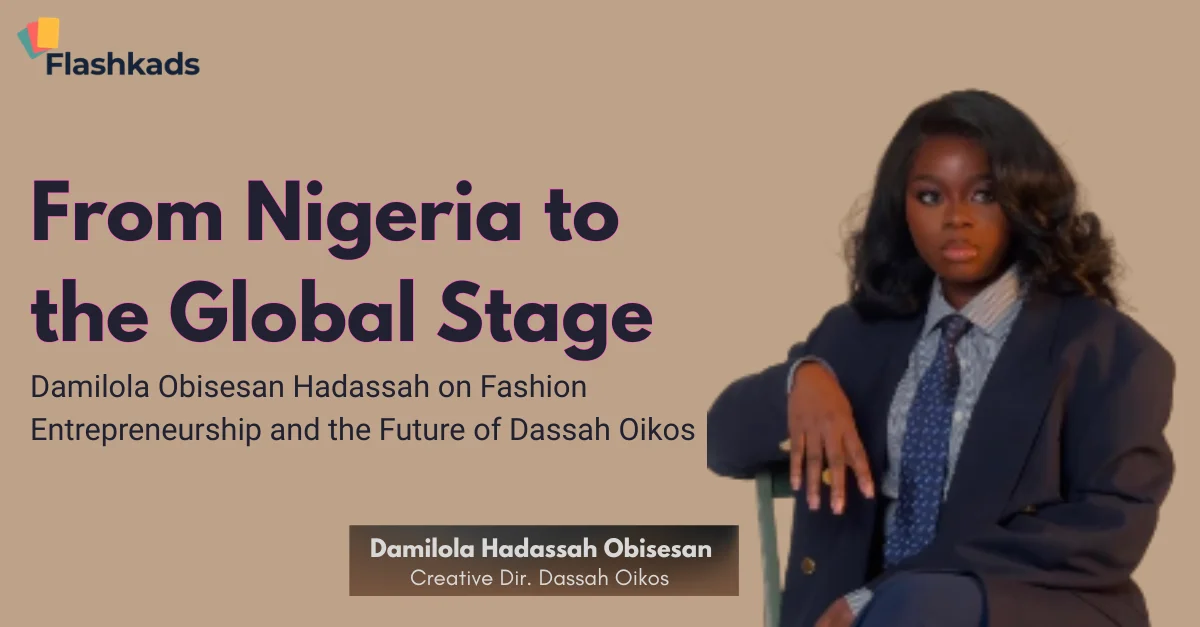
I recently spoke with Damilola Hadassah Obisesan, Founder and Creative Director of Dassah Oikos, about her journey through fashion, the realities of building a fashion business in Nigeria and her plans to introduce the brand’s prom dress collection to a global audience.
For Damilola, fashion has never been limited to designing attractive clothes. She is deeply interested in the entire process, the creative direction, production, operations, customer experience and commercial decisions required to build a sustainable brand.
“Fashion is creative, but it is also a business,” she explained. “You can design something beautiful, but you must also understand how to produce it efficiently, price it correctly, deliver it on time and create an experience that makes the customer trust your brand.”
That combination of creativity and commercial thinking forms the foundation of Dassah Oikos. Through the brand, Damilola has been able to explore fashion as both an artistic expression and an entrepreneurial venture.
During our conversation, Damilola spoke openly about the difference between creating clothes and building a fashion company.
Many designers begin their careers because they enjoy making clothes. However, the transition from designer to entrepreneur often introduces challenges that creative training alone may not prepare them for. A fashion entrepreneur must manage suppliers, production timelines, customer expectations, employees, cash flow and changing market demands.
According to Damilola, this is one of the most important realities aspiring designers must understand.
“A fashion brand cannot survive on creativity alone,” she said. “The business needs structure. You need to understand your costs, the people you are designing for and what makes your product valuable to them.”
This lesson has shaped the way she approaches Dassah Oikos. Every collection must express the brand’s creative identity, but it must also make commercial sense. Materials, labour, packaging, logistics and marketing must all be considered before a final price is attached to a garment.
She noted that many emerging designers struggle because they underprice their work. In an attempt to attract customers, they may set prices that do not cover the full cost of producing an outfit. The business becomes busy, but not necessarily profitable.
“You may have several orders and still discover that you are not making enough money to grow,” Damilola explained. “That is why fashion entrepreneurs must learn to separate activity from profitability.”
Nigeria offers significant opportunities for fashion entrepreneurs. The country has a large population, a strong culture of dressing for occasions, and a growing appreciation for locally made products. Weddings, birthdays, graduations, corporate events and other celebrations continually create demand for fashion.
At the same time, designers operate in a difficult environment. The cost of fabrics and production materials can change quickly. Access to finance remains limited for many small businesses, while unreliable infrastructure increases operating expenses. Designers may also face difficulties finding skilled workers who can consistently meet production standards.
Damilola believes that Nigerian fashion entrepreneurs must learn to build systems that help them manage these challenges.
“We are operating in an environment that requires resilience and flexibility,” she said. “Sometimes, the cost you calculated at the beginning of a project changes before production is complete. You have to plan carefully and still be ready to adjust.”
She also emphasised the importance of understanding the customer. A designer may have a strong creative vision, but a successful brand must know who it is serving, what that customer values and how much the customer is willing to pay.
This does not mean abandoning creativity to follow every trend. Instead, it means finding the point where a designer’s vision meets a genuine market need.
“For me, the question is not only, ‘Is this beautiful?’” Damilola said. “I also ask, ‘Who is this for? Where will she wear it? How does she want to feel in it? Why would she choose this dress over another option?’”
Our conversation moved from the realities of the local market to the global possibilities available to Nigerian fashion brands.
African designers are receiving increased international attention, but Damilola understands that global expansion requires more than posting beautiful pictures online. A brand must be prepared to meet international expectations in sizing, finishing, delivery, communication and customer service.
“Going global means that your systems must be ready,” she explained. “It is not only about having customers outside Nigeria. You must be able to give them accurate information, deliver quality consistently and meet the expectations of people who may never visit your studio.”
For Dassah Oikos, the planned prom dress collection represents an important step in this direction.
Prom is a major event for many young people in countries such as the United States, Canada and the United Kingdom. It is a moment of celebration, transition and self-expression. For many young women, choosing the right dress is one of the most important parts of the experience.
Damilola sees an opportunity for Dassah Oikos to create prom dresses that combine elegance, confidence and distinctive design.
“A prom dress should make the wearer feel seen,” she said. “It should reflect her personality and give her confidence. We want to create pieces that feel special, memorable and worthy of such an important moment.”
The global strategy for the collection will require careful planning. International customers need clear size guides, professional photographs, detailed product descriptions and reliable delivery information. The brand must also consider return policies, payment systems, production timelines and customer support across different time zones.
Damilola acknowledged that international growth must be approached deliberately.
“We do not want to enter the global market without being prepared,” she said. “The goal is to create a collection that can compete in design and also deliver a professional customer experience.”
Digital storytelling will play an important role. Rather than simply displaying dresses, Dassah Oikos will need to communicate the inspiration behind the collection, the craftsmanship involved and the emotions each piece is designed to create.
The brand can also work with models, stylists, photographers and content creators in its target markets. Strategic partnerships with boutiques, prom platforms and fashion influencers may help introduce the collection to relevant audiences.
For Damilola, taking Dassah Oikos global is not about losing the brand’s identity. It is about presenting that identity in a way international customers can understand and appreciate.
“A Nigerian brand can be globally relevant without becoming disconnected from where it comes from,” she explained. “Our perspective, creativity and attention to detail are part of what makes us different.”
Damilola’s interest in fashion entrepreneurship also extends beyond Dassah Oikos. She is the Founder of Preneurin Forum, a nonprofit organisation created to help young and emerging fashion designers build profitable businesses and sustainable careers.
Through Preneurin Forum, she hopes to address the knowledge gap that prevents many talented designers from turning their skills into stable businesses.
“Many young designers know how to create, but they need support with pricing, branding, operations and customer management,” she said. “I want them to understand that fashion can become a serious and profitable career when it is supported by the right structure.”
Her work with both Dassah Oikos and Preneurin Forum reflects the same belief: creativity should create value for both the customer and the creator.
As our conversation ended, it was clear that Damilola’s ambition for Dassah Oikos goes beyond launching another collection. She wants to build a brand capable of competing internationally while contributing to the growth of Nigeria’s fashion ecosystem.
The prom dress collection represents a new chapter, one that combines her love for design with her interest in strategy, operations, and global business development.
“I am excited about what is possible,” she said. “There is still a lot of work to do, but I believe Nigerian fashion brands can build products that are respected and desired anywhere in the world.”
For Damilola Obisesan Hadassah, the journey from a Nigerian fashion business to a global brand will require patience, preparation and consistency. However, with a clear vision for Dassah Oikos and a commitment to helping other designers through Preneurin Forum, she is not only building a fashion brand. She is helping to shape what fashion entrepreneurship can become.